



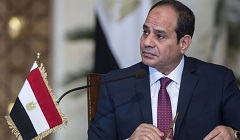
Egyptian President Abdel-Fattah El-Sisi urged the international community to support the efforts of Sudan's neighbors in resolving the conflict as well as in dealing with its immediate humanitarian consequences.
The Egyptian president made those remarks in a speech during a virtual meeting for the African Union’s Peace and Security Council (PSC), held at the level of heads of state and government, to discuss ways to resolve the conflict in Sudan.
The meeting was chaired by Uganda’s President Yoweri K Museveni and was attended by a number of African heads of state and government as well as a number of high-level officials, including Arab League Secretary-General Ahmed Aboul-Gheit and the UN Secretary-General’s Special Envoy for the Horn of Africa Hanna Tetteh.
It discussed efforts toward finding a sustainable ceasefire and resuming a civilian-led democratic process in the country, effective humanitarian action, and ways to ensure regional stability.
"I call on humanitarian organizations and donor countries to provide the necessary support to Sudan's neighboring countries so they can continue to fulfil this role," El-Sisi said.
The Egyptian president stressed that the humanitarian consequences of Sudan's crisis extend beyond its borders and impact neighboring countries, thus necessitating close coordination with them.
"Egypt has met its obligations in this regard by accepting approximately 150,000 displaced Sudanese citizens to date, in addition to hosting approximately five million other Sudanese citizens who are treated as nationals," El-Sisi noted.
Egypt will continue coordinating with its partners and relief organizations to provide urgent humanitarian aid to alleviate a deteriorating situation, he said.
During his speech, the Egyptian president emphasized the necessity for regional parties "to assist the Sudanese in ending the current crisis and achieving a consensus to address the underlying causes that led to its outbreak in the first place."
Source: Al-Ahram Online