



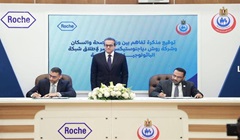
Egypt’s health minister, Khaled Abdel Ghaffar, oversaw the signing of a memorandum of understanding to launch a national digital pathology network linking seven medical sites, aimed at accelerating cancer diagnosis and raising diagnostic accuracy to 92 percent, the Ministry of Health said in a statement.
The initiative, signed between the Ministry of Health and Roche Diagnostics Egypt at the Egyptian Centre for Disease Control (EGYCDC), will deploy artificial intelligence-supported pathology systems to strengthen diagnostic capacity across hospitals and healthcare facilities, particularly for oncology services.
The memorandum was signed by Mohammad Hassani, assistant minister for health initiatives, and Moataz Nassef, chairman of Roche Egypt Diagnostics, in the presence of senior health officials, including representatives from the Teaching Hospitals and Institutes Authority, the Secretariat of Specialized Medical Centers, and the Presidential Women’s Health Initiative.
Abde Ghaffar said the network represents a strategic step in Egypt’s transition toward precision medicine and digital diagnostics, describing it as the foundation of a nationwide digital infrastructure to improve diagnostic services and treatment outcomes.
The system will allow pathology slides to be digitized and analyzed using artificial intelligence, enabling specialists to review cases remotely and reducing the impact of geographical distance on access to expert medical opinions.
The first phase will connect seven strategic locations, including the Egyptian Centre for Disease Control, the Egyptian Medical Research Centre at Ain Shams University, Nasser Institute Hospital, the Ministry of Health’s Central Laboratories, and specialized oncology centers in Sohag, Kafr El-Sheikh, and Damanhur.
Health officials said the technology is expected to increase diagnostic accuracy from 85 percent under conventional methods to about 92 percent, with sensitivity reaching 96.3 percent and specificity 93.3 percent.
Artificial intelligence can also detect about five percent of cases that may be missed by the human eye, according to the ministry.
The minister also highlighted progress under the Presidential Women’s Health Initiative, which reduced the average time between suspected diagnosis and the start of treatment from 270 days to 49 days, an 82 percent improvement, with plans to shorten the period further to 28 days.
Abdel Ghaffar said the digital pathology network would help accelerate diagnosis and improve early detection, noting that the proportion of cases detected in the first and second stages of disease has risen from 34 percent to 70 percent.
The minister described cooperation with Roche and AstraZeneca as a model of public-private partnership supporting Egypt’s healthcare modernization efforts, adding that the network could help position Egypt as a regional center of excellence in medical diagnostics across the Middle East and Africa.
Following the signing ceremony, Abdel Ghaffar toured laboratories at the Egyptian Centre for Disease Control to review the digital systems and artificial intelligence algorithms used by pathologists to analyze full histopathology slide images with high precision.
Source: Al-Ahram Online