


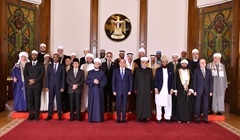
President Abdel Fattah El-Sisi met with an international delegation of ministers, muftis, and heads of Islamic councils participating in the 36th International Conference of the Supreme Council for Islamic Affairs.
Egypt is hosting the conference on Jan. 19 and 20, 2026. The meeting included Dr. Osama Al-Azhari, minister of religious endowments, and Dr. Ahmed Nabawi Makhlouf, secretary-general of the Supreme Council for Islamic Affairs.
Ambassador Mohammad El-Shennawi, the official spokesperson for the presidency, said President El-Sisi welcomed the attendees and expressed his hopes for the conference's success. The president highlighted the event’s primary goals: formulating unified strategies to confront extremist ideology, discussing the role of religious institutions in promoting societal stability, and exploring ways to utilize digital tools in modern Islamic outreach.
Moreover, El-Sisi noted that holding the conference at this "pivotal moment" serves as a bridge between traditional Islamic values and the digital future. He affirmed that Islam is a living religion that remains inseparable from contemporary life and modern developments.
The president emphasized that nation-building is fundamentally tied to human development. To that end, he said the Egyptian state has prioritized investing in human capital to cultivate a conscious and enlightened generation capable of addressing modern challenges and contributing to development.
According to the official spokesperson, El-Sisi affirmed that Egypt’s vision for religious discourse is built on firm foundations. He stressed the importance of "rescuing religion" from becoming a site of conflict or abuse. He warned against the hijacking of faith by extremist currents that transform it into a vehicle for violence, bloodshed, and destruction, which he noted often leads to atheism.
The president concluded by stressing the vital role scholars must play in confronting terrorist ideas, particularly within digital and social media spaces. He called for elevating religious discourse to serve the broader goals of national security, development, and the protection of human dignity.
Source: Egypt Today