



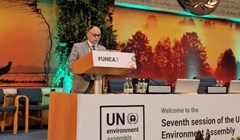
Dr. Ali Abo Sena, CEO of the Egyptian Environmental Affairs Agency (EEAA), headed the Egyptian delegation to the seventh session of the UN Environment Assembly (UNEA-7), held in Nairobi, Kenya, from December 8 to 12.
The session was held under the theme “Advancing Sustainable Solutions for a Resilient Planet” and aimed to support global environmental action and strengthen multilateral cooperation.
It was chaired by Dr. Abdullah bin Ali Al-Amri, President of the Environment Authority and current President of the Assembly, and attended by representatives of member states, international organizations, global environmental bodies, civil society, youth, and the private sector.
In his opening remarks, Dr. Abo Sena expressed his appreciation to Dr. Abdullah bin Ali Al-Amri, President of the current session, as well as to the government and people of Kenya for their excellent organization and warm hospitality.
He affirmed Egypt’s full solidarity with the statement delivered by Mozambique on behalf of the African Group, noting that the theme of the session places a shared responsibility on the international community to move from proposing solutions to implementing them. He stressed that solutions without implementation remain mere aspirations, and that success can only be achieved when resolutions are translated into tangible actions that safeguard the future of the planet.
Dr. Abo Sena added that Egypt looks forward to outcomes that reflect the shared aspirations of all member states, emphasizing that the true measure of progress lies not in written texts, but in fulfilled commitments and concrete action. He expressed hope that the international community would demonstrate the political will needed to act decisively, rather than merely adopt decisions, to protect the shared future of humanity.
He further noted that discussions held during the Assembly reflected the seriousness of member states in taking measures to protect the environment, with consensus reached on several key issues. However, the discussions also highlighted major challenges facing international environmental action, particularly the widening gap between environmental goals and the available means of implementation, especially for developing countries.
He stressed that financing, technology transfer, and capacity building are essential components of implementation, describing them as the lifeblood of sustainability rather than optional tools. He emphasized that developing countries should not be forced to choose between development and environmental protection, but must be enabled to achieve both.
Dr. Abo Sena underscored that Egypt views water, energy, and food security as interconnected and inseparable pillars of sustainable development. He stressed that water is not merely a natural resource, but an existential right, and that enhancing water resilience must be central to the work of the United Nations Environment Program. He noted that a truly “resilient planet” cannot be achieved without strengthening the resilience of water resources, and called on the Assembly to prioritize the sustainable management of transboundary waters in accordance with the principles of international law and mutual benefit.
Concluding his remarks, Dr. Abo Sena affirmed that Egypt will remain a strong advocate for the effective implementation of environmental commitments and will continue to cooperate with regional and international partners to ensure the sustainable management of the planet’s resources. He stressed that environmental protection is not a choice, but a collective responsibility that requires genuine political will and sincere international cooperation, reiterating Egypt’s commitment to contributing actively to a safer and more equitable environmental future for generations to come.
Source: Egypt Today