



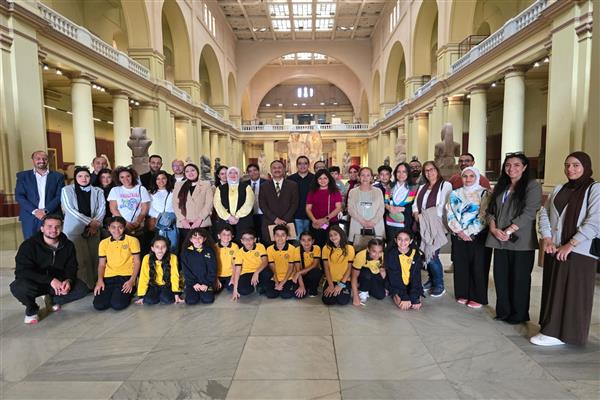
The Egyptian Museum in Tahrir organized a cultural and educational program, under the title “Discovering Ancient Egypt—A Day at the Egyptian Museum," to mark its 124th anniversary. The program is part of the museum’s cultural and educational role and its commitment to fostering archaeological awareness among young people and strengthening the connection of new generations to Egypt’s cultural heritage.
The program targeted a group of primary school students at Manchester International School, aged 11 to 12. The students had an interactive educational experience that combined exploring the history and archaeological collections of the museum and learning through observation, dialogue, and participation, along with several hands-on activities that helped simplify concepts related to ancient Egyptian civilization and archaeology.
The events were organized by the museum’s Cultural Activities Department in collaboration with the Education Department and the Children’s Museum. In his welcoming remarks, Prof. Dr. Ali Abdel Halim, Director General of the Egyptian Museum, provided an overview of the museum’s history and significance, highlighting its role in preserving Egypt’s archaeological heritage, making it accessible to the public, and fulfilling its cultural and educational mission.
To encourage students to engage in active learning and participate in sharing knowledge, they gave a presentation on the Temple of King Narmer. The presentation explored its historical and artistic significance and its implications related to the early foundation of the Egyptian state and the unification of the country. It also highlighted symbols and imagery it contains that reflect concepts of authority and kingship in Ancient Egypt.
The program’s activities included a guided tour of the museum's exhibition halls and a visit to the Children's Museum, which is attached to the main museum, to explore its role in presenting archaeological and historical knowledge through interactive and creative learning methods.
To conclude the program, the museum’s education department organized an interactive workshop simulating archaeological excavations. This workshop provided students with an opportunity to explore the fundamental principles of archaeology, emphasizing the importance of careful observation and a systematic approach to handling archaeological finds. The workshop aimed to reinforce their understanding that archaeology is based on scientific research, evidence, and analysis—not only the excavation of artifacts.
The program highlighted the importance of using interactive cultural and educational activities to showcase cultural heritage through innovative educational approaches targeting different age groups. It also explored how it is vital to develop children’s observation, critical thinking, and research skills, as well as raising their awareness of the importance of preserving cultural heritage as a shared responsibility.
🖋️ Source: Ministry of Tourism and Antiquities Online Portal