



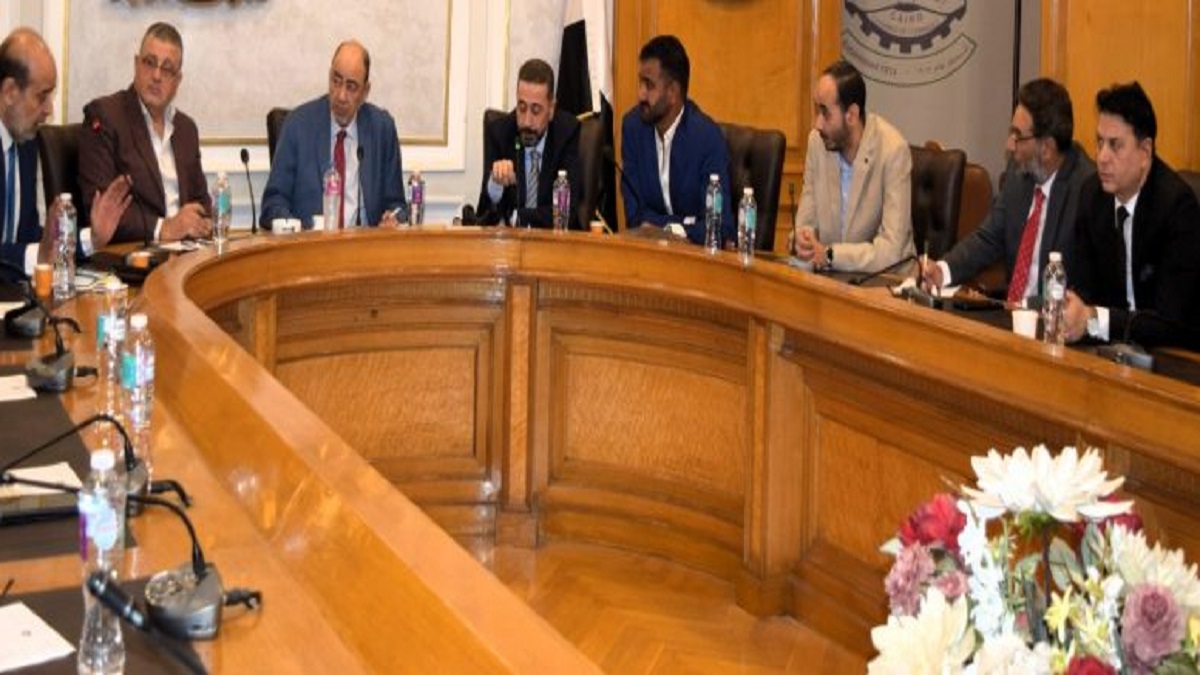
The Medical Supplies Division of the Cairo Chamber of Commerce held an expanded meeting to discuss a number of topics and issues of importance to the medical supplies sector, foremost among them the results of the latest meeting between a delegation from the division, headed by Mohamed Ismail Abdo, and Dr. Hisham Stait, Chairman of the Unified Procurement Authority, to discuss a number of joint files and issues.
During the meeting, the head of the division submitted a comprehensive study to the Chairman of the Unified Procurement Authority regarding a number of medical supply items whose prices need to be increased to reflect the actual and final cost of these products. The Chairman of the Authority agreed to reconsider these prices in light of the study submitted by the division.
The two sides also discussed ways to localize the medical supplies industry by seeking to manufacture certain products that are not currently produced locally. This would contribute to increasing the percentage of local manufacturing and deepening domestic production in the sector. They also discussed ways to enhance communication between the division and the Authority in order to resolve any obstacles facing workers and company owners in the sector.
Mohamed Ismail Abdo, head of the Medical Supplies Division at the Cairo Chamber of Commerce, praised the efforts of Dr. Hisham Stait and his cooperation during the past period, as well as his fulfillment of his commitment regarding the payment of outstanding dues owed to medical supplies suppliers and the acceleration of payment procedures. He noted that only a small portion of these dues remains unpaid. He also expressed his appreciation for the Chairman’s cooperation and warm reception during the meeting, saying: “The Chairman of the Authority is extremely cooperative with the division” on various joint issues, which supports continued cooperation between the two sides in the public interest and for the benefit of the medical supplies sector.
Abdo added that the meeting also addressed the new regulations for supply operations proposed by the Authority, including dividing the Authority’s suppliers into two groups, with each group making deliveries once every two months, in line with the quantities required by hospitals and medical centers affiliated with the Ministry of Health, the Health Insurance Authority, the Comprehensive Health Insurance Authority, and university hospitals and medical centers, including shipping and transportation costs. He noted that the Authority has set a maximum supply period of 35 days, from the date the supply order is issued until the delivery is completed.
Abdo explained that, during its meeting, the division decided to establish several specialized committees covering all aspects of the sector, including obstacles, development proposals, growth, and industrial localization. Among these committees is one headed by Dr. Ahmed El-Moslemy, Deputy Head of the Division, to study the new supply regulations and prepare proposals for dealing with them.
The division’s members also proposed dividing Egypt’s governorates into several groups, with supply orders issued separately for each group to facilitate deliveries. This is particularly important because supplies are delivered to each hospital or medical center affiliated with the Unified Procurement system, from Alexandria to Aswan. They also proposed making deliveries through health directorates, which would then distribute the supplies to the hospitals and medical centers under their jurisdiction, helping reduce logistical burdens and facilitate supply operations.
Mohamed Ismail Abdo stressed that the division seeks to deepen local manufacturing in the field of medical supplies and equipment and is placing all its resources at the service of the industrial sector in this field. He noted that local industry has succeeded in producing around 65% of the total medical supply items, estimated at approximately 8,500 items, in less than four decades. He explained that in 1983, only medical gauze and enemas were manufactured locally, followed by syringes, before the industry expanded significantly in subsequent years.
The head of the Medical Supplies Division pointed out that the medical supplies industry has grown thanks to the efforts of pioneering generations and now covers a significant portion of local market needs. More importantly, it has entered the export market, with many products being exported to Arab and African markets. He expressed hope that production and export figures could increase tenfold over the next ten years, particularly as the industrial sector benefits from initiatives to facilitate industrial lending and reduce interest rates to just 5%.
Abdo called on leading traders who are members of the General Division to enter the industrial sector, even through partnerships with major local manufacturers. This would contribute to increasing investment and expanding medical supplies production. He revealed that three medical supplies are now being manufactured in Egypt for the first time with entirely Egyptian investment, noting that a large number of manufacturers among the division’s members are planning to inject new investments and add production lines for new products.
In this regard, he praised Dr. Khaled Raafat Alyan and Dr. Omar Ismail for the major advances they have achieved in local manufacturing. They have succeeded in producing numerous important medical supplies, including rapid test kits for detecting viruses, for which demand increased significantly during the COVID-19 pandemic.
Mohamed Ismail Abdo explained that the division has formed a committee to study the legal status of deductions made from the dues of parties dealing with the Unified Procurement Authority who are members of the division. These include deductions for stamp tax collected for the benefit of the Federation of the Four Medical Syndicates, as well as fees deducted for the benefit of the Syndicates of Applied Arts and Engineers.
He noted that, according to the division’s position, these fees are unlawful because no legislation has been issued regulating their imposition on medical supplies suppliers. He explained that the medical stamp tax, under the law establishing it as a financial resource for medical syndicates, is imposed on services provided by doctors of various specialties to patients in hospitals and medical centers.
Abdo added that, from the division’s perspective, deducting this tax from manufacturers, traders, and importers of medical supplies constitutes an unlawful collection. He also said that the method of collection results in duplicate—or rather, repeated—payments, explaining that the manufacturer pays it when selling to the distributor, the distributor pays it when selling to the trader, and the trader pays it again when selling and supplying the hospital, meaning that it is collected three times, according to his statement.
Mohamed Ismail Abdo also announced the formation of a committee to study the sector’s problems, along with another committee tasked with intensifying communication with the business community operating in the medical supplies sector and working to quickly identify and resolve the obstacles it faces.
For his part, Dr. Ahmed El-Moslemy, Deputy Head of the Division, praised the efforts of Minister of Industry Engineer Khaled Hashem, particularly following the launch of several initiatives to support the industrial sector. These include an initiative to rescue financially distressed factories by connecting them with those interested in investing in Egypt.
El-Moslemy noted that the General Division could benefit from this initiative by bringing together major traders in the sector who wish to enter industrial activity with companies operating in the sector that are seeking financing to expand their industrial investments.
El-Moslemy stressed that this approach would bring together technical expertise, working capital, and strong product distribution channels, supporting the expansion of local manufacturing and increasing its ability to meet domestic market needs and expand exports.
Source: Akhbar El Yom News Portal