



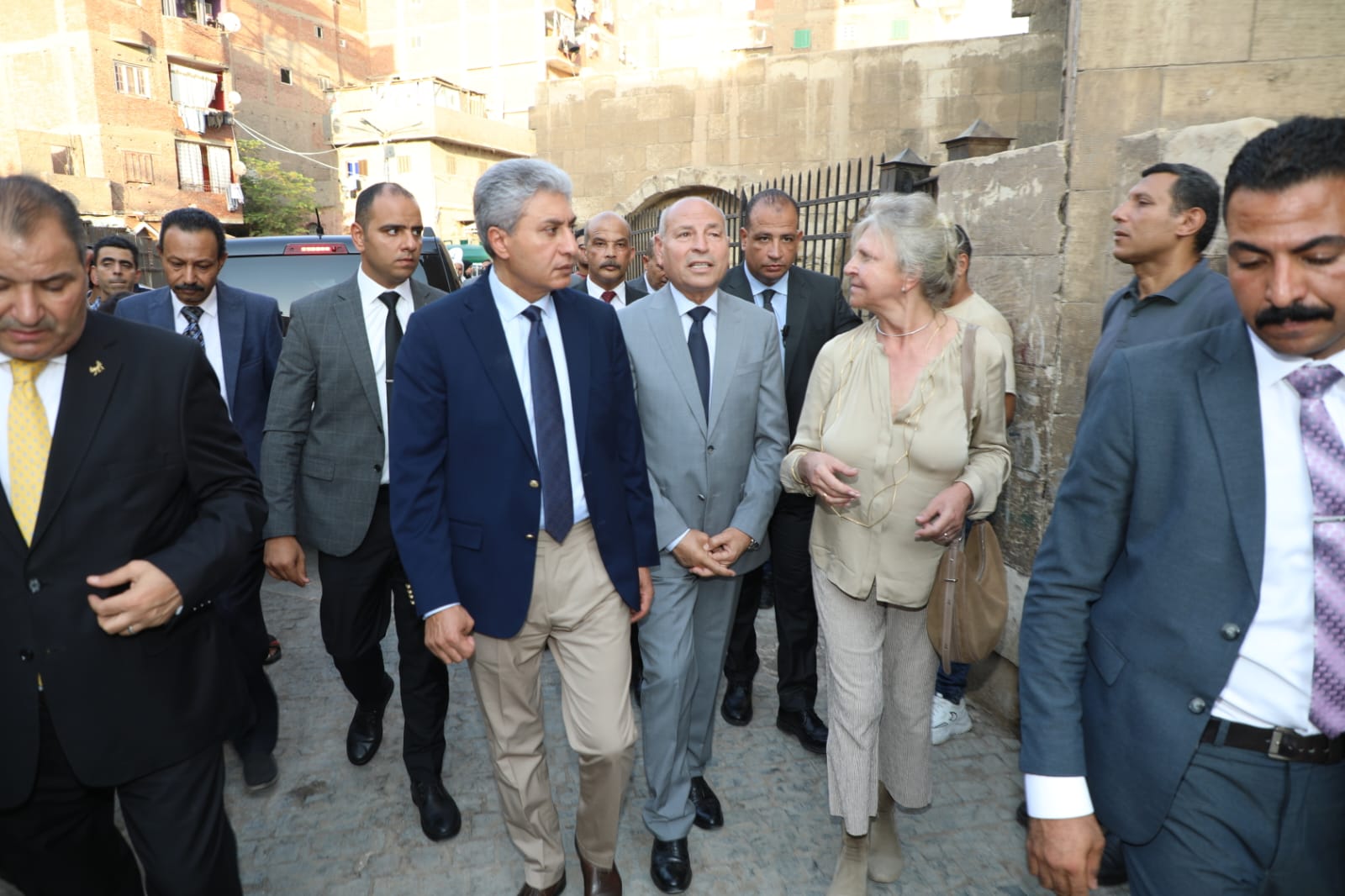
Cairo Governor Dr. Ibrahim Saber stated that the Cairo Governorate, in coordination with the Ministry of Tourism and Antiquities and all relevant state agencies, has carried out renovation work around the Dome of Sultan Al-Ashraf Qayitbay. These efforts included upgrading roads and access routes, improving sidewalks, enhancing the lighting system, removing encroachments, and elevating the visual appeal to reflect the significance of this unique monument and reinforce the area's status as one of the most important cultural and tourist destinations.
The governor's remarks were made during his participation with Minister of Tourism and Antiquities Sherif Fathy in the inauguration ceremony of the Dome of Sultan Al-Ashraf Qayitbay, located within his famous complex in the Mamluk Desert in the Al-Gamaleya neighborhood, following its renovation.
The event was attended by Deputy Cairo Governor Dr. Ahmed Anwar Attia Al-Adl and Ambassador Robert Silverman, Chargé d'Affaires of the United States of America.
Governor Saber said that, under President Abdel Fattah El-Sisi, the Egyptian state has given exceptional attention to the renovation of Historic Cairo. He added that this effort goes beyond restoring monuments to include a broad civilizational project aimed at reshaping the area's urban character and returning its beauty and deserved standing.
Moreover, Saber stated that the inauguration of the Dome of Sultan Al-Ashraf Qayitbay today is not merely the reopening of one of the most prominent Islamic monuments. Rather, it embodies Egypt's vision of preserving cultural heritage and reviving Historic Cairo, ensuring that it remains a beacon of culture and civilization as well as a global destination reflecting the grandeur of Egyptian history.
Saber also expressed sincere gratitude to the Ministry of Tourism and Antiquities, the U.S. Ambassadors Fund for Cultural Preservation, and all organizations that contributed to the project. He praised the fruitful cooperation between the Egyptian government and the United States through the Integrated Cultural Tourism Management Project, funded by USAID. This project has supported the restoration and revitalization of several distinguished historic buildings in Cairo, including the Sabil of Mustafa Sinan, the Sabil of Hassan Agha Koklian, the Sabil and Kuttab of Ruqayya Dudu, the Zawiya and Sabil of Farag ibn Barquq, the Gate of Manjak al-Silihdar, the Tekiya of Taqi al-Din Al-Bustami, the Sabil of al-Amir Shaykhu, and the Bimaristan of Al-Mu'ayyad Sheikh, demonstrating the success of international partnerships in heritage preservation.
Saber further stated that Egypt is now reaping the benefits of a comprehensive vision to revive the heart of historic Cairo. Visitors can now follow a continuous civilizational path beginning at the Citadel of Salah al-Din al-Ayyubi, passing through the Al-Sayyida Aisha area—enhanced by the removal of the old bridge and the restoration of its urban value—then proceeding to the development of the Magra al-Oyoun Aqueduct and the Fustat Hills Gardens, and culminating at the Mamluk Cemetery and the Dome of Sultan Qayitbay. This comprehensive civilized framework reflects the magnitude of achievements in the capital.
Furthermore, Saber stated that these renovation plans are part of the state's comprehensive strategy to revive both Historic Cairo and Khedival Cairo. This strategy includes the development of several heritage-rich areas, such as the surroundings of Azbakeya Garden and the Borsa, the Sharifin Triangle, Muski, and Qadi al-Fadil, along with projects to develop Al-Darb al-Ahmar and the areas around Al-Sayyeda Nafisa and Imam Al-Shafi'i, among others. He emphasized that this development project seeks to strike a balance between preserving the capital's historical identity, upgrading its urban fabric, and maximizing the cultural and tourism benefits of its unique heritage.
The governor also stated that what Cairo is experiencing is not merely scattered development plans but a comprehensive civilizational project aimed at reshaping the city's urban and historical landscape. It seeks to transform its archaeological treasures into elements of cultural, tourism, and economic attraction, thereby strengthening Cairo's position as one of the world's greatest historic capitals.
He added that this vision reflects the Egyptian state's commitment to making heritage preservation a fundamental pillar of sustainable development.
The governor also expressed gratitude to all parties involved in the project, affirming the governorate's ongoing cooperation with various state institutions to advance the development and revitalization of Historic Cairo, preserve its civilizational heritage, and showcase it to the world in a manner befitting Egypt's grandeur and history.
The Dome of Sultan Qayitbay is one of the most outstanding architectural works of the Circassian Mamluk era. It was built on orders of Sultan Al-Ashraf Abu Al-Nasr Qayitbay, whose reign marked a remarkable period of artistic and architectural flourishing in Egypt and is considered among the most prosperous eras in Islamic architecture.
The dome is distinguished by its intricately carved stone decorations on its exterior surface, showcasing a highly complex style that represents the pinnacle of Mamluk architecture and craftsmanship. It is part of an integrated architectural complex that includes a school, a sabil, a Kuttab, a waterwheel, a rub' (residential complex), another dome, a royal maq'ad, and a residence. Due to its exceptional artistic and historical significance, the dome and its architectural ensemble were featured on the Egyptian one-pound banknote.
The Dome of Qayitbay, is distinguished by its finely carved stone decorations on the exterior, showcasing a technique that reached its peak of prosperity and artistic development during the Circassian Mamluk era.
Source: Media Department, Cairo Governorate