



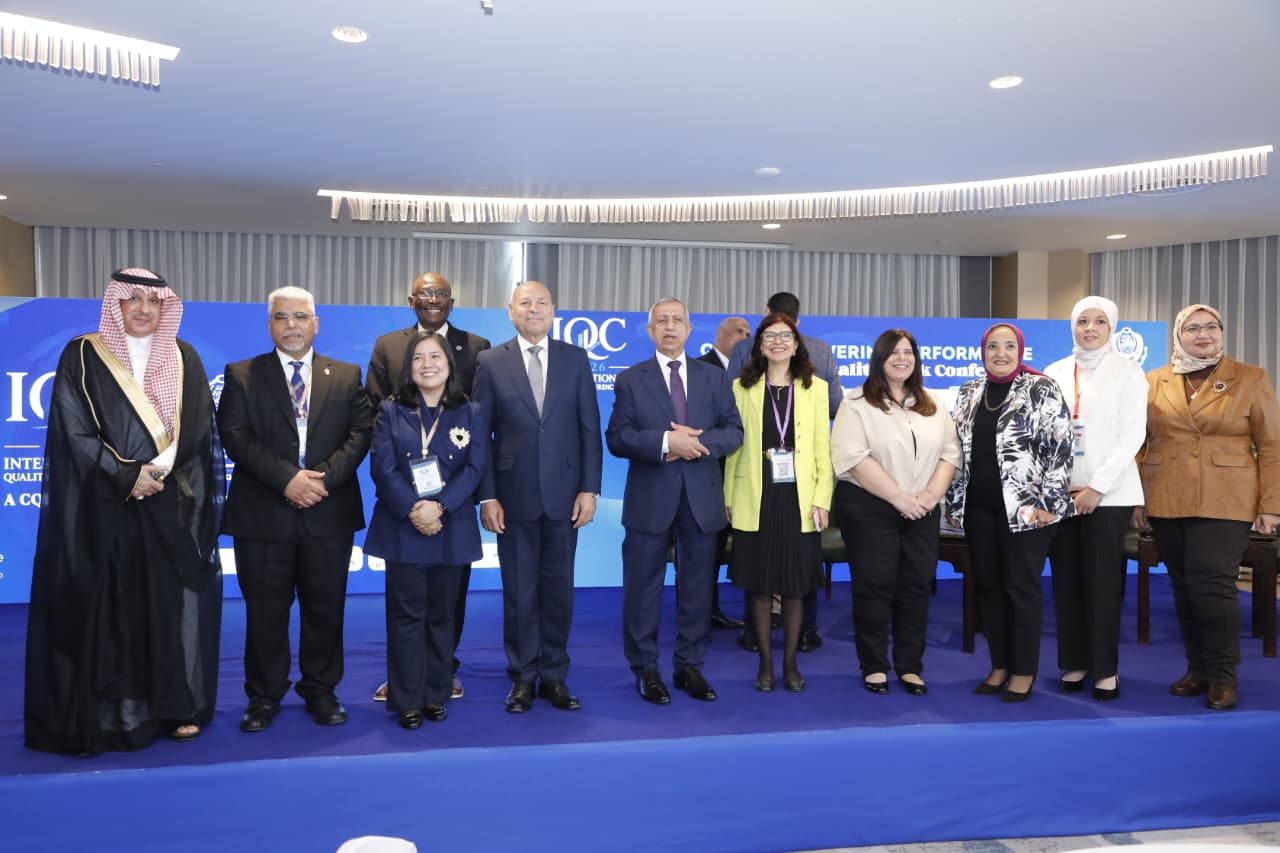
Cairo Governor Dr. Ibrahim Saber, accompanied by Dr. Ismail Abdel Ghaffar, President of the Arab Academy for Science, Technology, and Maritime Transport, attended the Quality Conference held by the academy on November 10–11. The conference was themed “Quality: Powering Performance." The event aligns with the events of World Quality Week.
The conference was attended by Dr. Alaa Abdel Bari, Vice President of the Academy for Graduate Studies; Dr. Abel Adekola from Wilkes University in the United States; Dr. Mohammad Abdel Rabbo, Dean of the Institute of Productivity and Quality at the Arab Academy; Dr. Carmela Palma, representative of the International Institute for Excellence; Dr. Ayman Al-Bayaa, Assistant Minister of Industry for Digital Transformation and CEO of the Industrial Modernization Center; Dr. Sharifa Fouad Sharif, Executive Director of the National Institute for Governance and Sustainable Development and Professor in the Public Department at Cairo University; Brigadier General (Gen. Staff) Zaki Al-Gayar, Military Advisor to the Cairo Governorate; as well as several experts, specialists, and representatives from academic and executive institutions.
Governor Saber said that organizing the quality conference comes at a time when it is increasingly significant to adopt the concepts of quality and institutional excellence as fundamental pillars for realizing sustainable development and improving the performance of institutions and their capability to keep pace with rapid changes.
Saber added that choosing the conference’s theme, “Quality: Powering Performance," reflects a genuine awareness of the importance of transforming quality from a set of standards and regulatory procedures into an integrated institutional culture and an operational framework that directly influences performance efficiency, productivity, service quality, and the ability to innovate and achieve the best results.
Saber also stated that the Egyptian state, under President Abdel Fattah El-Sisi, prioritizes modernization of the state administrative apparatus, improving the performance of government institutions, promoting the principles of governance and digital transformation, and upgrading the quality of public services. He added that building a modern state goes beyond infrastructure development and the implementation of mega projects but extends to improving institutional operating systems, building the capacity of human resources, and promoting a culture of quality and excellence across all state institutions.
The governor further said that Cairo Governorate, as Egypt’s capital and the country’s largest urban settlement, comes at the forefront of institutions committed to applying quality standards in executive and service-related work. He added that the governorate’s responsibility is not limited to managing utilities and delivering services but extends to offering citizens the best possible living standards, effectively addressing their needs, and developing operating mechanisms to improve efficiency, accelerate delivery, and reinforce discipline.
Moreover, Saber said that the governorate is working on establishing the concept of quality through several integrated pillars. Most notably, the pillars include upgrading the public services system to provide citizens with easy access to those services, improving performance efficiency within district offices and executive bodies, and intensifying on-site inspection campaigns. They also include measuring progress rates, upgrading public cleanliness standards, improving the urban environment, and maintaining and upgrading road networks and utilities, as well as expanding the use of digital solutions and developing mechanisms for receiving and promptly addressing citizens’ complaints.
The governor also said that the quality of government performance is not measured solely by the number of implemented projects but by the real success of its tangible influence on citizens' lives and by delivering high-quality services in a timely manner, with the highest standards of efficiency, transparency, and discipline.
Saber also stated that the partnership between the Cairo governorate and the Arab Academy for Science, Technology, and Maritime Transport is of particular importance, as it serves as a model for integration between the operational expertise of government institutions and specialized scientific and academic expertise. He added that institutional performance cannot be improved in isolation from scientific and research institutions and that leveraging academic expertise and specialized training programs represents a true investment in human capital, which is the cornerstone of any successful development process.
The governor added that the governorate is committed to strengthening cooperative ties with the academy and leveraging its scientific, training capabilities and accumulated expertise. This collaboration will contribute to developing employees’ administrative and leadership skills, utilizing modern knowledge in the executive workplace, improving planning, management, and monitoring methods, and instilling the concepts of quality and institutional excellence, the governor said.
Governor Saber expressed his aspiration for expanding areas of cooperation in the coming phase, particularly in capacity building, specialized training, institutional work system development, and the utilization of technology and innovation in public service delivery. This step will help achieve tangible outcomes that improve the performance of the governorate’s executive bodies and the quality of public services.
The governor further praised the scientific and enlightening role played by the Arab Academy for Science, Technology, and Maritime Transport, under the leadership of Dr. Ismail Abdel Ghaffar. This distinguished Arab academic institution has successfully strengthened its position in education, training, and scientific research, serving as an exemplary model for integrating knowledge with practical application and development goals.
Saber also said that the real challenge facing our institutions today is not merely meeting quality standards but ensuring their sustainability and integrating them into daily practice across all levels of operation so that quality becomes a shared responsibility of every leader and every employee and a true measure of an institution’s success and its ability to achieve its goals.
The governor hoped that during the conference, the participants—experts, specialists, executives, decision-makers, and academics—would exchange viewpoints and experiences and present practical models and successful practices that open new avenues for our institutions to improve their performance and enhance their competitiveness.
The governor concluded his remarks by emphasizing that quality is not merely a goal to be achieved but rather an ongoing journey of development, evaluation, and improvement, and that investing in quality is an investment in people, institutions, and the nation.
The conference is addressing several important issues and topics, foremost among them recent trends in quality management and institutional excellence and the role of artificial intelligence applications in performance development, as well as promoting the concepts of governance and productivity and improving institutional efficiency.
🖋️ Source: Media Department, Cairo Governorate