



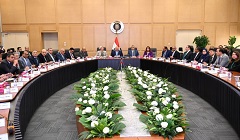
Deputy Prime Minister and Minister of Industry and Transport Kamel Al-Wazir chaired the 21st meeting of the Ministerial Group for Industrial Development, with participation from the Ministries of Military Production, Electricity, Environment, Local Development, and Housing.
Also in attendance were representatives from the Arab Organization for Industrialization, the Federation of Egyptian Industries (FEI), and the Industrial Development Authority (IDA).
The meeting focused on mechanisms to maximize the use of sugarcane waste (bagasse), converting it into value-added products or ethanol instead of burning it as an alternative fuel in sugar factories.
The Ministry of Supply and Internal Trade presented its plan to integrate bagasse into various industries, including particleboard, paper, fiberboard, and ethanol production.
In response, the minister of industry instructed the IDA to coordinate with the Ministry of Supply and the FEI to promote private sector investment in this field, leveraging modern technologies.
These efforts aim to reduce pollution caused by bagasse burning, optimize resource utilization, and cut down on imports of raw materials used in the paper, wood, and fiberboard sectors.
The meeting also reviewed progress on localizing animal feed production using agricultural and livestock waste, with particular emphasis on utilizing palm fronds in the manufacturing of medium-density fiberboard (MDF).
Al-Wazir called for expanding the committee to include the Ministries of Supply and Public Enterprises, along with the FEI, to scale up investment and manufacturing capacity.
Minister of Environment Yasmine Fouad highlighted ongoing implementation measures under the National Strategy for Agricultural Residues. The strategy includes an executive plan linked to a geographic map detailing agricultural waste distribution across Egypt’s governorates.
Egypt generates an estimated 40 to 45 million tons of agricultural waste annually, which holds significant potential for conversion into animal feed and organic fertilizers.
Al-Wazir underscored the importance of enhancing output from existing facilities and establishing new PVC production plants to meet domestic demand and support industry growth.
Source: Daily News Egypt