



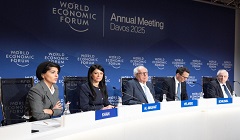
Rania Al-Mashat, Egypt’s Minister of Planning, Economic Development, and International Cooperation, participated in several discussions on global growth, inflation, gender equality, and the future of development in Africa. This came during the World Economic Forum (WEF) 2025 in Davos, Switzerland, themed “Collaboration for the Intelligent Age.”
At the Future of Growth Champions meeting, Al-Mashat joined other leaders, including Faisal Alibrahim, Minister of Economy and Planning of Saudi Arabia; Lawrence Summers, Director of the Mossavar Rahmani Center for Business and Government at Harvard Kennedy School; Raghuram G. Rajan, Professor of Finance at the University of Chicago’s Booth School of Business; André Hoffmann, Chairperson of the Board of Massellaz; and Samaila Zubairu, President and CEO of the African Finance Corporation.
Referring to the International Monetary Fund’s World Economic Outlook, Al-Mashat discussed global growth projections, expected to reach 3.3% this year and next year, noting this figure falls below the 3.7% historical average. She anticipated growth improvements in sub-Saharan Africa and a slowdown in Europe and emerging markets.
Al-Mashat outlined Egypt’s national economic development narrative, explaining that the ministry integrates planning and international cooperation to maximize the use of domestic and foreign resources for inclusive and sustainable growth.
Al-Mashat added that the ministry’s structure aims to enhance its role in preparing, implementing, and monitoring the economic and social development plan and boosting economic diplomacy to drive development financing, ultimately targeting high-quality, sustainable, and inclusive economic growth through increased foreign direct investment and industrial localization.
Al-Mashat affirmed that global challenges since 2020, including regional and international tensions, have hindered growth, particularly in developing and emerging countries.
Al-Mashat also explained that as central banks adopt monetary easing in early 2025, global inflation is expected to decline, with more measured monetary policy aimed at stimulating economic activity without affecting price stability.
She emphasized economic diversification as key to supporting sustainable economies by shifting towards productive sectors and green transformation, creating new industries and jobs. However, this requires restructuring skills and providing education and vocational training aligned with market needs.
Al-Mashat also participated in the “Inflation: Past, Present, and Future” session alongside Julio Velarde, Governor of the Central Bank of Peru; Martin Schlegel, Chairperson of the Swiss National Bank; and Martin Wolf from the Financial Times.
Al-Mashat highlighted that Egypt is implementing integrated policies to manage public finances, target inflation through monetary policies, and govern public investment spending, including capping public investments to reduce inflation.
Al-Mashat highlighted steps taken by Egypt since March 2023 to address rising inflation, saying that “These policies have helped build trust between local and foreign investors and have provided a foundation for macroeconomic stability.”
Furthermore, during the “Bridging the Gender Gap for Resilient Economies” session, Al-Mashat emphasized that “achieving gender equality between women and men is essential for inclusive growth, a resilient economy, and a fair transition.”
Source: Daily News Egypt