



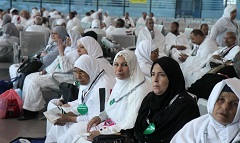
Major General Ashraf Abdel-Moetti, assistant minister of interior for administrative affairs and CEO of the Egyptian Hajj Mission, announced on Sunday the arrival of 4,000 Egyptian pilgrims from the Hajj Lottery Mission to Medina.
Abdel-Moetti confirmed that flights transporting pilgrims to both Medina and Mecca have commenced, as part of the Hajj Lottery Mission’s air bridge between Egypt and Saudi Arabia. The transportation efforts will continue in the coming days to complete the transfer of all pilgrims to the Holy Land.
He added that officials from the Hajj Mission are present at King Abdulaziz International Airport in Jeddah to receive and guide pilgrims upon arrival. They are overseeing arrival and grouping procedures for the journey to Mecca, ensuring smooth transfers to hotels situated in the central area near the Grand Mosque.
Mission officials are also reviewing accommodation preparations daily to ensure all arrangements are in place before the pilgrims' arrival. This aims to guarantee their comfort and reduce waiting times during check-in.
Abdel-Moetti noted that the travel plan is designed to streamline logistics; half of the pilgrims will arrive at Medina Airport and return home from Jeddah Airport, while the other half will arrive at Jeddah and return from Medina.
He emphasized that readiness levels at both Prince Mohammed bin Abdulaziz Airport in Medina and King Abdulaziz International Airport in Jeddah have been raised to accelerate arrival procedures. This comes in line with directives from Minister of Interior Mahmoud Tawfik, who has instructed all relevant bodies to ensure care for the "Guests of God" and facilitate their pilgrimage.
The mission's teams are operating around the clock to provide continuous support for the pilgrims—from departure to return—ensuring a safe and smooth Hajj experience.
In the 1445 Hajj season, approximately 600 Egyptian pilgrims died during an extreme heatwave. These individuals did not have official Hajj permits and, as a result, lacked access to designated camps in the Arafat and Mina areas—locations where all pilgrims are required to stay during specific days of the pilgrimage. Many of these unregistered pilgrims had entered Saudi Arabia using visit visas rather than official Hajj visas and remained in the country until the Hajj season, often relying on unauthorized or dubious operators.
That is why Egypt’s Grand Mufti and Head of the General Secretariat for Fatwa Authorities Worldwide Nazir Ayyad has affirmed that performing Hajj without an official permit from Saudi authorities constitutes a violation of Islamic law.
Source: Egypt Today