

The final
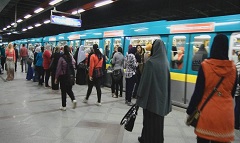
section of the third green line of the Greater Cairo Metro, known as 3C, did a
dry run with passengers on Wednesday, marking the completion of this
eco-friendly track.
Spanning 7.1 kilometers, the 3C offers commuters a seamless journey across Cairo and Giza, linking key destinations, such as Giza’s Mohandessin with Cairo University.
With a total length of 41.2 kilometers and 34 stations, Line 3 functions as a crucial link between the eastern and western parts of Greater Cairo, integrating with various transport modes, including the Monorail, Light Rail Transit (LRT), Third Metro Line, Super jet Station, and Bus Rapid Transit (BRT).
The latest development aligns with Egypt’s commitment to implementing sustainable mass transit systems.
Overseen by French transportation firm RTP Dev and funded by the European Union, Cairo Metro’s third line underscores Egypt’s efforts toward a greener transportation network.
The LRT came into service in 2023, linking Cairo with the New Administrative Capital. The monorail’s East Nile line’s first phase is expected to supplement the LRT to link the new capital with Greater Cairo.
The monorail was initially set to open in 2023, but following delays in constructing the first line, the East Nile branch is scheduled for trial operation by October this year.
The two-line monorail network will extend for almost 100km and be served by 35 stations. The monorail has cost $4.5 billion to implement, according to Arab Contractors, one of three companies implementing the project, alongside Bombardier Transportation and Orascom Construction.
The two lines will have a maximum capacity of 45,000 passengers per hour in each direction.
The government has executed a comprehensive plan to develop the first and second metro lines at a cost of roughly 38 billion Egyptian pounds to improve services.
The plan included developing metro line trains and infrastructure. When it opened in 1988, the first line of the underground metro was dubbed the ‘fifth pyramid’ for its being a breakthrough in transport engineering.
The government has signed a raft of deals with global corporations to purchase new rolling stock that were installed on the first and second lines, in addition to revamping the existing trains.
The state has devised a comprehensive plan for Greater Cairo to have six metro lines by 2030, within the framework of Egypt’s Sustainable Development Strategy.
Source: Egyptian Gazette