



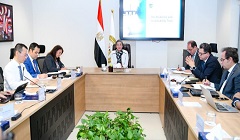
Egyptian and International Monetary Fund (IMF) officials have initiated discussions around a $1.2 billion long-term financing package to support Egypt's climate-related projects.
The meeting, held in the New Administrative Capital, brought together Minister of the Environment Yasmine Fouad, representatives from other government ministries and entities, and the IMF's Mission Chief for Egypt Ivanna Vladkova Hollar.
This new financing is being considered under the IMF's Resilience and Sustainability Facility, which provides extended funding to help countries address longer-term challenges like climate change.
Minister Fouad said the meeting complements previous meetings between the government officials, on one side, and between the government and the IMF Fund, on the other side, to discuss coordination and cooperation frameworks to enhance environmental and climate policies in Egypt.
These previous meetings, she added, dealt with a set of clarifications between the two sides about the required reforms in climate policies, Fouad noted, according to a statement released following the meeting.
Egypt has launched its National Climate Strategy 2050 and updated Nationally Determined Contributions (NDC) twice in recent years.
Under its National Climate Strategy 2050, Egypt aims to reduce carbon emissions using renewable and alternative energy, increasing the share of renewable energy to 42 per cent by 2030.
According to Fouad, the government seeks to collaborate with the IMF to build upon its existing national climate initiatives.
She noted that the government aims to leverage the experiences of other countries that have undertaken similar efforts, such as Morocco and Bangladesh.
The minister explained that the government is keen to identify the strategies and policies needed to enhance Egypt's resilience and sustainability, define the requirements and financing mechanisms for green growth, and increase green investments in both the public and private sectors.
Additionally, the minister noted that the government needs to accelerate its efforts to transition to a low-carbon economy, particularly in the energy, transportation, and petroleum sectors.
Source: Al-Ahram Online