



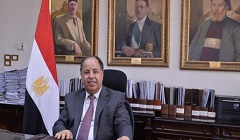
Egyptian Minister of Finance Mohammad Maeet has reviewed efforts made by the Ministry’s Accounts Sector and Financial Directorates to implement Prime Minister’s directives to boost and maximize revenues.
The objective is to rationalize public spending of all public economic bodies in light of the current global economic crises and consequences.
“Pressure on the budgets of various countries, including Egypt, has stepped up efforts to maximize the benefit of automated financial systems in strengthening the governance of the revenue and expenditure system in a bid to enable us to have a more flexible management of the state’s public finances,” Maeet said, pointing to the need to estimate the sound financial position in the wake of exceptional circumstances facing the global economy.
Minister Maeet has said automated financial systems provide real-time information about public revenues and expenses, “enabling us to arrange priorities accurately”, as he put it, with full commitment to managing the basic needs of citizens.
He pointed out to expanding the umbrella of social protection to the segments most affected by the inflationary wave, and maintaining the path of financial discipline via reducing the budget deficit and the debt-to-GDP ratio in the medium term.
He said the government achieved a two percent primary surplus, pointing out that spending rationalization does not apply to the Ministry of Health, its affiliated entities, i.e. university hospitals, or other authorities managing food supplies, petroleum products, gas and their derivatives.
Maeet has reiterated the importance of continuing efforts to raise the efficiency of public spending to achieve development and economic goals, prioritizing investment projects in a way that contributes to achieving optimal exploitation of the state’s resources.
He called for preparing economic feasibility studies for these projects with a specific timetable to maximize returns and increase the state’s general revenues.
Moreover, he reiterated giving priority in government contracts to Egyptian products, even if their price exceeds their foreign counterparts within the limits of 15 per cent, in line with the state’s efforts aimed at increasing local production and localizing the industry.
Source: The Egyptian Gazette