



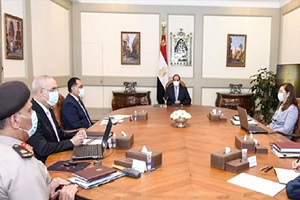
President Abdel-Fattah El-Sisi urged state officials on Saturday to localize the components of the water desalination technology in a bid to achieve further progress in this field.
El-Sisi stressed maximizing the amount of water coming from desalination and treatment water stations, a statement by the presidential spokesman, Bassam Rady, read.
He urged the integration of the water desalination strategy with the state’s general policy for the wise management of water.
The president ordered officials to continue conducting further studies and experiments in this field to reach the best outcome.
The president’s directives come “within the general framework of building the national capacity of the state in all fields,” the statement noted.
The meeting was attended by Prime Minister Mostafa Madbouli, Minister of Planning Hala El-Saeed, Minister of Housing Assem El-Gazzar, Presidential Adviser for Urban Planning Amir Sayed Ahmed and Chairman of the Armed Forces Engineering Authority Ihab El-Far.
The meeting reviewed the state’s strategic plan in terms of seawater desalination plants, Rady said.
During the meeting, the president reviewed the operational desalination plants and those under construction or set to be built.
El-Sisi also reviewed the plan to distribute the suggested plants nationwide together with the cost and capacity of these projects, including projects to desalinate Red Sea water using new and renewable energy.
El-Gazzar last month revealed that 14 seawater desalination plants are being built in Egypt, with a total capacity of 476,000 m3 of water per day, at a cost of EGP 9.71 billion.
The 14 plants, expected to be completed by June 2022, are being constructed in the governorates of Marsa Matrouh, the Red Sea, North Sinai, South Sinai, Port Said, Daqahliya, Suez and Alexandria, El-Gazzar's statement read.
When built, the plants will bring Egypt’s tally to 90 desalination stations with a total capacity of 1,307,69 million m3 per day due to the operation of 76 existing seawater desalination plants, with a total capacity of 831,690 m3 per day, the minister said.
The plan works to provide alternative sources of drinking water through desalination in coastal governorates and reuse treated water, he added.
Source: Al-Ahram Online