



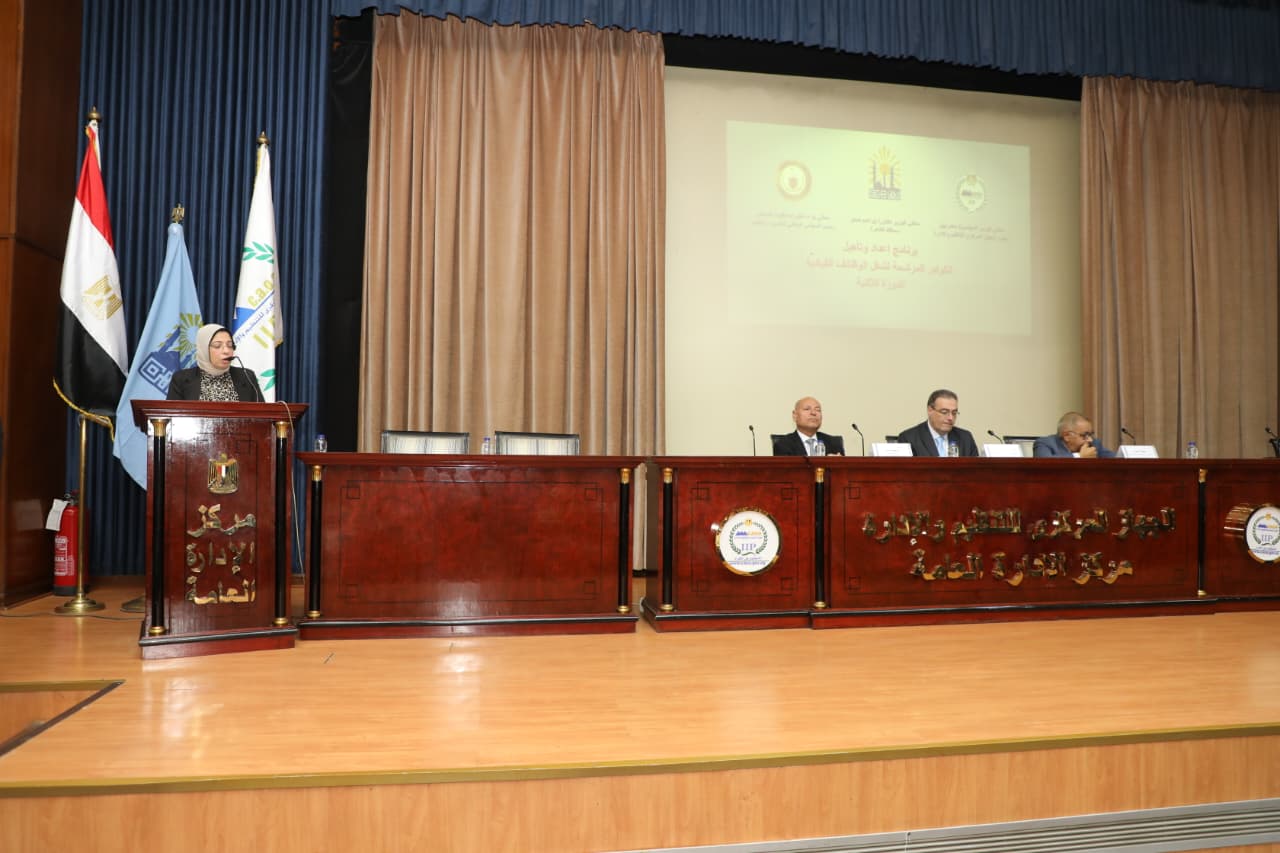
Cairo Governor Dr. Ibrahim Saber, accompanied by Head of the Central Agency for Organization and Administration Hatem Nabil and Chairman of the National Council for Training and Education Dr. Safwat El-Nahas, attended the inauguration of the second session of the training program titled "Qualifying Personnel to Pass Leadership Position Examinations within Cairo Governorate." The training program is being held from September 28 to October 1 at the Leadership and Management Development Center. The program is a collaborative effort with the Central Agency for Organization and Administration, the National Council for Training and Education, and the Azhar University.
The inauguration ceremony was also attended by Deputy Cairo Governors Mona El-Batrawi and Dr. Ahmed Anwar El-Adl, Omar El-Shafei, and several senior officials from the Cairo Governorate.
During his speech at the event, Governor Saber stated that the program aligns with the directives of President Abdel Fattah El-Sisi to develop human capabilities and invest in human capital, given it is one of the fundamental pillars for building an efficient and effective public administration capable of continuing the development drive and improving the quality of services provided to citizens.
Saber added that the Cairo governorate places great importance on developing the skills of public employees and qualifying them, considering Cairo’s position as the capital and the significant responsibilities it undertakes in serving citizens. He continued by saying that developing human capabilities is an ongoing responsibility and a key pillar to improve performance, serving nearly 22 million residents and daily visitors.
Moreover, Saber stated that the responsibilities of Cairo governorate require leaders who are capable of managing crises and addressing various challenges. He added that individuals serving citizens must be sufficiently qualified to carry out their responsibilities effectively. He further said that the governorate is continuously developing, improving public services, and preserving the capital’s status and standards.
Saber added that responsibility requires the ability to innovate and develop solutions that support development and drive change. He further said that continuous learning and training are fundamental to any individual assuming leadership positions.
Saber also said that the reassignment of district chiefs and senior leaders across different districts enables them to gain diverse experience and effectively deal with various challenges and problems.
Governor Saber stated that building the state cannot be achieved solely by upgrading systems and facilities; it begins with individuals who are capable of managing these systems effectively.
The governor also said local administration constitutes the state’s first line of engagement with citizens, particularly as public employees deal on a daily basis with numerous issues that directly affect the lives of citizens, including healthcare, education, encroachments, sanitation, and other public services. This necessitates a qualified and capable administrative apparatus that can interact with citizens efficiently and deliver services effectively.
The governor also stressed the necessity of building trust between citizens and administrative bodies, adding that every citizen accessing a public service should receive attentive service, respectful treatment, and dedicated efforts to address their requests. He further said that law must be enforced firmly against violators to restore order and protect the rights of both the state and its citizens.
Governor Saber further said that the training program put that direction into practical steps by providing employees with the opportunity to upgrade their skills and broaden their knowledge. It also helps them be better prepared for the examinations required for leadership positions. He added the program reinforces the values of competence and merit while creating greater opportunities for qualified personnel capable of assuming responsibility and carrying out their duties efficiently and effectively.
The governor extended his heartfelt thanks and appreciation to the Central Agency for Organization and Administration for its fruitful cooperation and its ongoing efforts to enhance human resource management and strengthen the capacities of public employees throughout the state's administrative apparatus. He also praised the National Council for Training and Education for its valuable role in supporting and sponsoring the program.
Saber also extended his appreciation to all participants, adding that the efforts they invest in developing themselves and acquiring more knowledge and experience reflects a worthwhile investment in their professional future, the future of their institutions, and their ability to deliver better services to citizens.
Meanwhile, Head of the Central Agency for Organization and Administration Hatem Nabil said that training is a key component of selecting and preparing leadership, adding that choosing an employee for a leadership position does not mark the end of the qualification process. It rather means that the individual must undergo a comprehensive training program through which their professional, managerial, and behavioral competencies are developed, equipping them to meet the requirements and responsibilities of their new role.
Nabil added that second-line leadership development programs are designed to prepare personnel and staff members by equipping them with the experience and skills needed to assume greater responsibilities in the future. He also said that investing in human capital represents one of the most important pillars of administrative reform and the development of the state’s administrative apparatus.
For his part, Chairman of the National Council for Training and Education Dr. Safwat El-Nahhas praised Cairo governorate’s leadership development initiative as a distinguished and innovative program aimed at building a second line of leadership. He added the council intends to expand the implementation of the program to governorates across the country once it has been firmly established in Cairo governorate, ensuring that its benefits are not restricted to a single geographic area.
El-Nahhas added that this expansion would contribute to building a wider base of qualified talent and skilled professionals throughout Egypt. He further expressed his aspiration for the training program to serve as a model to be followed across Egypt. He also hoped it would be part of a sustainable framework for preparing and qualifying employees nominated for leadership positions in a manner that reflects the specific needs of each governorate and the nature of work within its institutions.
The training program for preparing personnel to pass leadership position examinations for employees of the Cairo governorate includes a set of comprehensive training modules designed to prepare participants to successfully pass this stage. These modules cover institutional and professional awareness, as well as the legislative frameworks governing work, foremost among them the Constitution, the Civil Service Law and its Executive Regulations, public finance rules, and the Code of Professional Conduct. The program also addresses information technology, cybersecurity, and information protection, in addition to developing participants’ thinking and analytical skills through training on IQ tests.
🖋️Source: Media Department, Cairo Governorate