


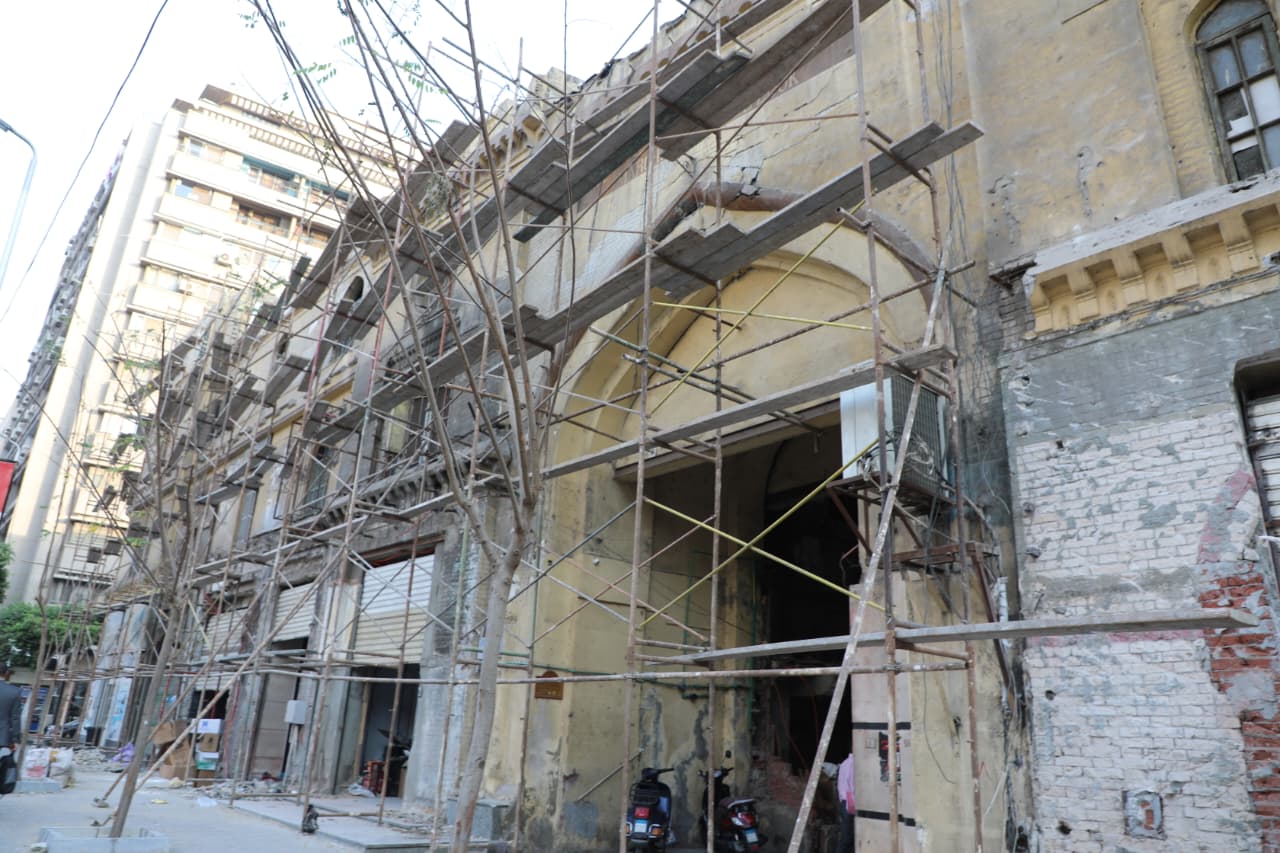
Cairo Governor Dr. Ibrahim Saber announced the start of the Bab Al-Louq Historic Market Restoration project. The project aligns with the Cairo governorate's intensive efforts to preserve urban heritage and revive the historic sites of Khedivial Cairo. It also aims to preserve the market's architectural characteristics and boost its economic and social role in the heart of the capital
Governor Saber said that the restoration is a collaborative effort among the Cairo Governorate, the Faculty of Engineering, Cairo University, the National Organization for Urban Harmony, the Market Traders Association, and civil society organizations.
Saber also stated that the project is an extension of Cairo governorate's vision, which prioritizes the preservation of the capital's visual identity and the revival of its architectural heritage. He added that coordination among government authorities, civil society, and academic partners is fundamental to regaining the splendor of historic buildings and markets in a manner befitting Cairo's rich heritage.
Saber further stated that the project will also include removing all encroachments and visual distortions that have accumulated on the façades over the decades. It will also involve meticulous restoration work based on heritage engineering principles to preserve the market's unique architectural characteristics and regain its original condition. Furthermore, occupants of the market units will unify, repaint, and upgrade their shop façades to reflect a civilized and aesthetically pleasing appearance befitting the building's historical significance. These upgrading works will be in cooperation with the governorate and the market occupants' association.
Bab Al-Louq Market is one of the most famous historic covered markets in downtown Cairo. It was inaugurated on May 1, 1912, at a time when modern Cairo was undergoing significant development.
The idea of establishing the market is closely associated with the Egyptian businessman and politician Yousef Aslan Qattawi Pasha, who contributed to the establishment of the Egyptian Central Markets Company to create modern markets patterned after European markets.
The market is characterized by its unique European-style architectural design. It spans approximately 6,200 square meters. When it was established, it featured modern ventilation and goods storage systems. This reflects a pioneering approach to modernizing commercial markets and improving health and regulatory standards during that period.
The market's activities were not limited to buying and selling, but for more than a century, it has formed an integral part of Cairo's economic and social memory. It hosted a wide range of commercial and artisanal activities. Consequently, preserving the market extends beyond restoring its appearance to maintaining a living architectural and heritage legacy.
🖋️ Source: Media department, Cairo Governorate