



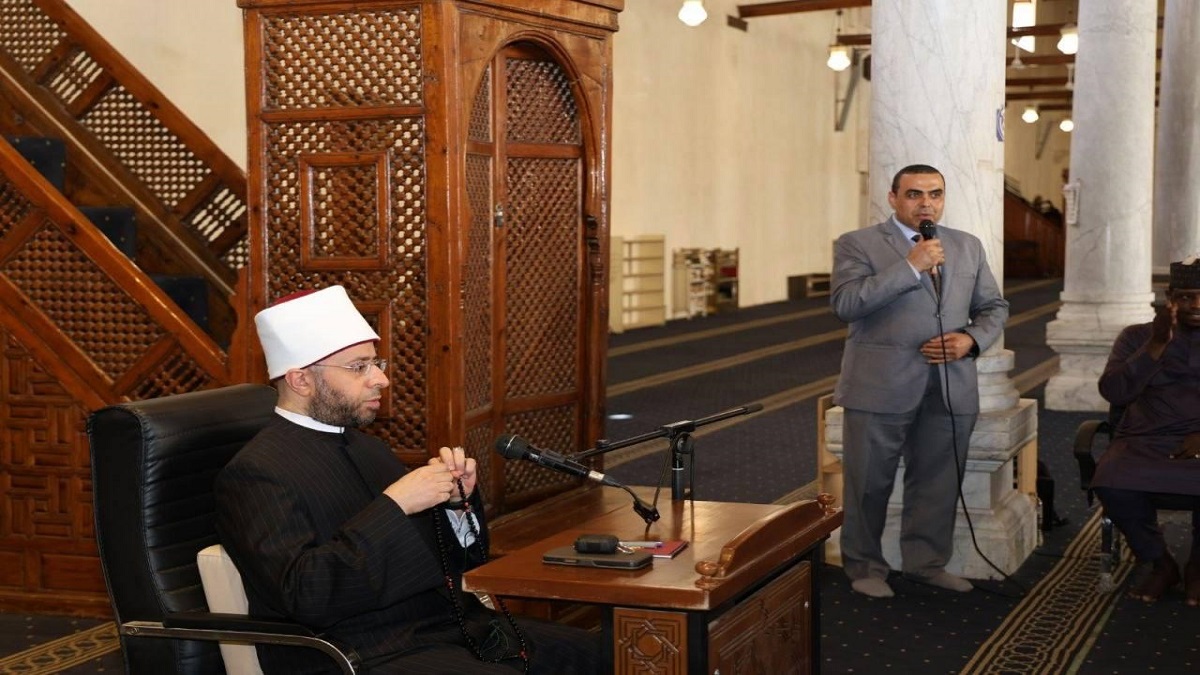
Dr. Osama Al-Azhari, Minister of Endowments and Chairman of the Supreme Council for Islamic Affairs, attended the launch of the "Arabic Language Program for Non-Native Speakers," organized by the Supreme Council for Islamic Affairs in cooperation with the Cairo Endowments Directorate at the Amr Ibn Al-As Mosque. The initiative is part of the Ministry of Endowments' and the Supreme Council's efforts to promote the Arabic language and strengthen its presence among international students from around the world.
The opening ceremony began with a recitation from the Holy Quran by Omar Bashir, a Nigerian student enrolled in the program. Addressing the international participants, the minister stated that the Supreme Council for Islamic Affairs currently provides scholarships to more than 500 international students through its International Students Support Department. He explained that the new program extends the council's mission to serve all international students—not only scholarship recipients—by helping them master the four essential language skills: listening, speaking, reading, and writing.
The minister added that the program was designed after studying previous experiences and reviewing leading references on teaching Arabic to non-native speakers. It also draws on the expertise of experienced specialists, with the goal of enabling participants to return to their home countries as ambassadors of the Arabic language, carriers of knowledge, and representatives of Al-Azhar's moderate approach and the values of tolerance and compassion.
He stressed that the initiative reflects the Supreme Council's sense of responsibility toward Muslims around the world. He also noted that Egypt's religious institutions—led by Al-Azhar, from which the Ministry of Endowments, Dar Al-Ifta, and the country's Sufi orders originated—work in close coordination to serve Islam, promote its values of moderation, and spread its message of tolerance.
The minister explained that choosing the Amr Ibn Al-As Mosque as the venue for launching the program carries significant historical and academic symbolism. As the first mosque established in Egypt and Africa, it marked the beginning of Islam's presence in the region and has historically served as a center of learning that graduated generations of scholars, imams, and preachers. He also noted that approximately 70 companions of the Prophet Muhammad (peace be upon him) helped determine the mosque's qibla direction.
For his part, Dr. Ahmed Nabawi, Secretary-General of the Supreme Council for Islamic Affairs, said the program reflects President Abdel Fattah El-Sisi's commitment to preserving and promoting the Arabic language. He added that, under the guidance and supervision of Minister Osama Al-Azhari, the council developed an academic program worthy of Egypt and Al-Azhar's distinguished status as historic centers of the Arabic language and Islamic scholarship.
Meanwhile, Dr. Mohamed Faisal, Professor of Linguistics at Al-Azhar University and member of the Ministry of Endowments' Technical Office, explained that the program was developed through a structured academic process. This included assessing learners' needs, reviewing leading international curricula for teaching Arabic to non-native speakers, and preparing educational content that combines language proficiency, Al-Azhar's moderate methodology, and an introduction to Egyptian civilization. The development process also addressed the main challenges in the field, identified the target audience, and relied on specialists with more than 20 years of experience in teaching Arabic to non-native speakers.
He added that after the program was announced through the council's official platforms, around 2,700 applications were submitted electronically. Of these, 500 applicants were non-Arabic speakers residing in Egypt—the program's target group. Placement tests were conducted for 119 applicants, resulting in the admission of 114 students, who were distributed across four proficiency levels.
The accepted students represent 15 countries, including India, Indonesia, Bangladesh, Nigeria, Thailand, Burkina Faso, Afghanistan, Belgium, Kenya, Guinea, the United States, Sierra Leone, and Cameroon, with Indian nationals making up the largest group of participants.
Dr. Faisal also noted that the in-person program is complemented by an online learning program, allowing students—particularly beginners—to access educational content using modern teaching methods.
At the conclusion of the ceremony, Mohamed Reda Al-Qasim, a student from India, together with several fellow participants from different countries, performed a religious chant that created a spiritually uplifting atmosphere.
The event concluded with Dr. Osama Al-Azhari leading the participants in a collective recitation of Surat Al-Fatiha, praying for the program's success and expressing hope that its graduates would become ambassadors of the Arabic language and representatives of Al-Azhar's moderate approach in their home countries. The ceremony ended with a commemorative group photograph.
Source: Al-Ahram portal