

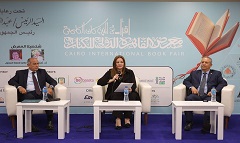
The seminar titled “Climate Change and the Challenges of Sustainable Development”, held in the International Hall as part of the “Cultural Diplomacy” theme at the Cairo International Book Fair, witnessed strong attendance from young people. The session featured Dr. Maged Boutros, Professor of Political Science at Helwan University, and Ambassador Wael Aboulmagd, Assistant Minister of Foreign Affairs for Climate, Environment, and Sustainable Development Affairs, and was moderated by media presenter Noha Tawfik.
At the beginning, Noha welcomed the attendees and noted that since 1992—when the United Nations recognized climate change as a serious issue—negotiations among countries have resulted in numerous agreements, including the Kyoto Protocol and the Paris Agreement, culminating in the Loss and Damage Fund announced at the Sharm El-Sheikh Summit in Egypt two years ago.
She added that the main goal of COP29 and other climate conferences has been to reach consensus among countries on plans to address climate change, develop and share them, and assist the most affected countries in adapting or rebuilding their lives.
Ambassador Wael Aboulmagd emphasized that Egypt faces significant environmental challenges, ranging from climate change and desertification to water scarcity and pollution. Therefore, protecting the environment and achieving sustainable development are among the country’s top priorities both now and in the future.
He explained that the Egyptian Ministry of Foreign Affairs plays a pivotal role in achieving these goals—particularly sustainable development—through international engagement and coordination with relevant ministries and entities at both the national and international levels.
He added that the Ministry works to align Egypt’s priorities in addressing environmental issues, climate change, and sustainable development internationally, within the framework of its foreign policy and related international agreements such as the Paris Agreement, the United Nations Environment Programme, and the Sustainable Development Goals. These efforts have wide-ranging impacts across sectors such as agriculture and beyond.
He also highlighted the Ministry’s participation in numerous activities across international forums related to environment, climate change, and sustainable development, including UN environmental conferences, climate summits, international negotiations, and forums. This is in addition to bilateral agreements with other countries, forming international alliances, and defending Egypt’s interests globally. He noted that these efforts are accompanied by support for institutions and organizations concerned with environmental issues, as well as the involvement of youth in environmental activities.
He further explained that, since the 2015 Paris Agreement, certain legal requirements have been set for all countries—most notably setting targets to reduce greenhouse gas emissions to limit global temperature rise to 2°C above pre-industrial levels. However, the Intergovernmental Panel on Climate Change has since confirmed that the most severe impacts of climate change can only be avoided if global warming is limited to 1.5°C by the end of this century.
Dr. Maged Boutros stated that climate change has become a critical challenge requiring urgent and effective action, as its harmful impacts are not limited to a specific area but extend to all aspects of life.
He pointed out that climate change refers to long-term shifts in temperatures and weather patterns. These shifts can occur naturally, due to changes in solar activity or major volcanic eruptions. However, since the 19th century, human activities have been the primary driver of climate change, mainly due to the burning of fossil fuels such as coal, oil, and gas.
He added that burning fossil fuels produces greenhouse gas emissions that act like a blanket wrapped around the Earth, trapping the sun’s heat and raising temperatures. He clarified that the main greenhouse gases responsible for climate change are carbon dioxide and methane.
Source: Official page of the Cairo International Book Fair