



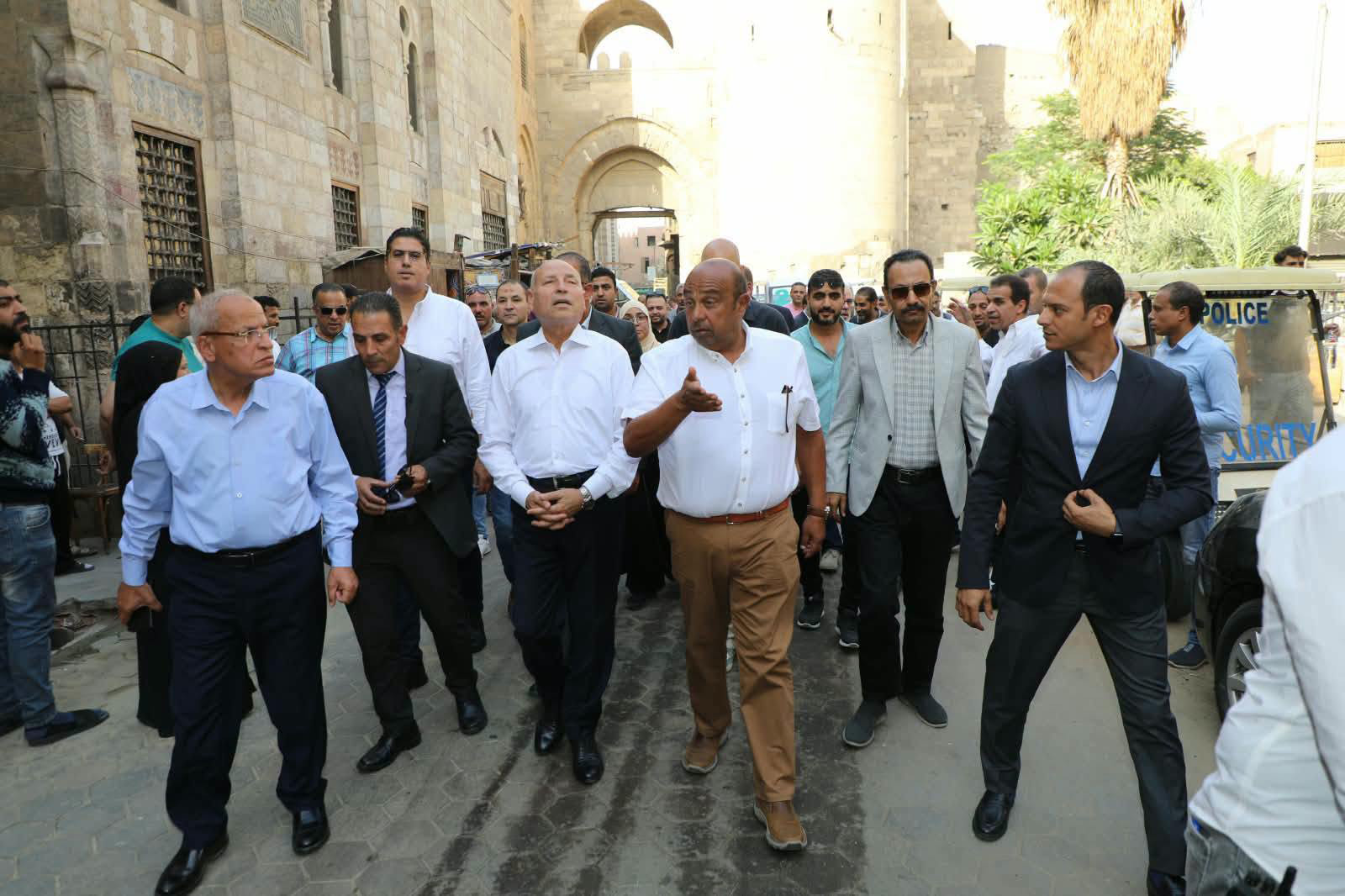
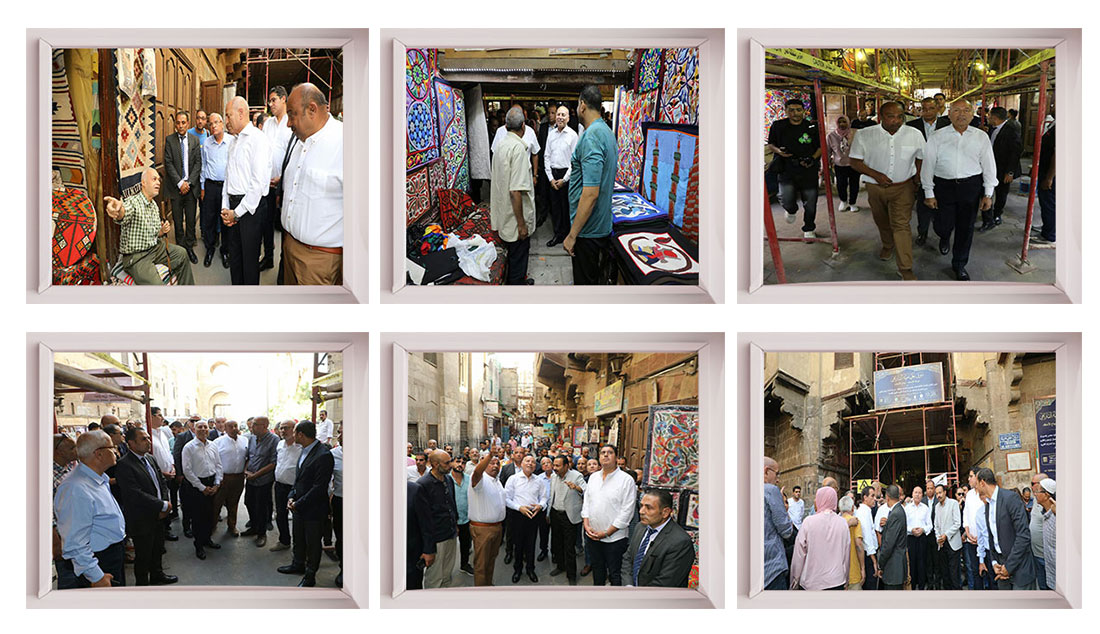
Dr. Ibrahim Saber, Governor of Cairo, inspected the launch of the first phase of restoration and rehabilitation works at the historic Khayamiya Market in Qasabat Radwan Bey, in Cairo’s Central District. The project aims to support the commercial activities and traditional crafts operating within the market, as part of efforts to preserve the architectural heritage and traditional crafts of Historic Cairo.
The project is jointly funded by the Aga Khan Foundation for Culture – Egypt and the ALIPH Foundation, at a cost exceeding EGP 100 million. The works are scheduled to take eight months, with completion expected in May 2027, in cooperation with Cairo Governorate and the Ministries of Tourism and Antiquities and Awqaf (Religious Endowments).
The project aims to preserve the market’s architectural and historical value, safeguard one of Cairo’s most prominent traditional handicraft centers, revive its cultural and economic role, and ensure that this heritage is passed on to future generations.
The Governor was accompanied during his tour by Dr. Ahmed Anwar Attia El-Adl, Deputy Governor of Cairo for the Western District; Sherif Erian, Executive Director of the Aga Khan Foundation for Culture – Egypt; Major General Ahmed Helmy, Director of Government Relations at the Foundation; Walid Hegazy, Director of Projects and Asset Management at the Aga Khan Foundation; Ashraf Botros, restoration consultant for Qasabat Radwan and the Khayamiya Market; and a number of senior Cairo Governorate officials.
The Governor emphasized that the project reflects the importance of treating heritage as a living asset that contributes to development, rather than merely as a witness to the past. It combines the preservation of historic buildings with improvements to the urban environment and support for traditional activities, strengthening residents’ connection to their cultural heritage and helping boost cultural tourism in the Al-Darb Al-Ahmar area.
He added that restoration works in the Khayamiya area form part of broader efforts to preserve the visual identity of Historic Cairo and strike a balance between safeguarding the authenticity of heritage sites and meeting the needs of contemporary life. These efforts will reinforce the market’s position as a destination for handicrafts and folk heritage, while ensuring that the colorful Khayamiya textiles and their distinctive patterns remain an integral part of Cairo’s identity and historical memory.
The Governor also confirmed that prior coordination had taken place with traders and shop owners in the area to ensure that commercial activities continue and that shops remain open throughout the restoration works. This arrangement aims to protect traders’ interests and livelihoods while preserving the site’s historical and archaeological value.
The Governor praised the Aga Khan Foundation’s role in supporting the Egyptian state’s efforts to preserve and revive its heritage. He highlighted the importance of cooperation with international heritage organizations in implementing projects that revitalize historic districts while maintaining their distinctive character and traditional activities.
The first phase of the Khayamiya Market restoration project includes upgrading shops, walls, and flooring; improving the lighting network; restoring wooden elements and mashrabiya screens; and rehabilitating the market’s wooden roof. The roof is considered one of the monument’s most distinctive architectural features, as Qasabat Radwan Bey is among the few historic markets that have retained their original roof. These works will help preserve its unique architectural characteristics.
The Khayamiya Market is located outside the historic Bab Zuweila, behind the Mosque of Al-Salih Tala'i, overlooking Khayamiya Street in the Al-Darb Al-Ahmar district. The street has historically been associated with the production, decoration, and sale of traditional tent textiles and is one of Cairo’s most prominent heritage craft districts.
The site is known as Qasabat Radwan Bey and is associated with commercial and urban structures dating back to the Ottoman period and the 17th century. The complex was established in 1062 AH (1652 AD) and was registered as an antiquity in 1951.
The site is associated with Prince Radwan ibn Abdullah al-Fiqari, one of the most prominent princes of the Faqari faction during the Ottoman period. He served as the commander of the Sultan’s military corps in Egypt for two years, followed by eight years as the commander of the Hajj pilgrimage. He lived during the reigns of Sultans Murad IV, Ibrahim I, and Mehmed IV, as well as several governors of Egypt. He died in 1066 AH (1655 AD).
The market features an architectural style that reflects the nature of trade and everyday life in Cairo throughout the centuries. Its diverse architectural elements include a main entrance leading to a covered passageway, open courtyards, stone storage units, a raised architectural seating area, red-brick upper floors, and ornately decorated wooden windows.
The covered roof structure, or saqifa, is one of the site’s most prominent features. Its roof consists of wooden planks supported by beams extending across its width, with rectangular openings that allow natural light and ventilation. The area also contains two prayer spaces, one to the east and the other to the west, serving traders and workers.
The market is closely associated with the traditional Egyptian craft of Khayamiya, which involves cutting colorful fabrics and embroidering them by hand to create geometric and artistic patterns. Over generations, the craft has evolved from the production of tents and ceremonial canopies into a traditional art form expressing Egyptian identity. It is associated with social and religious occasions and Islamic decorative motifs. Khayamiya products are used to decorate homes and streets, particularly during the holy month of Ramadan.
Today, the market’s historic storage units serve as workshops and shops where artisans produce, decorate, and sell Khayamiya textiles. This makes the site a living space that brings together historic architecture, economic activity, and traditional craftsmanship. It helps preserve inherited skills and artisans’ livelihoods while supporting the transmission of this craft to younger generations.
🖋️ Source: Media department, Cairo Governorate