


Egypt’s Minister of Water Resources and Irrigation, Hani Sewilam, stressed the importance of strengthening regional and international cooperation to confront the growing challenges of water scarcity and climate change.
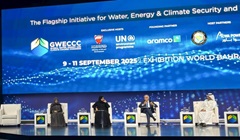
Speaking at a high-level ministerial session titled “Redefining the Integrated Water-Energy-Climate Nexus for a Sustainable Future” during the Second World Conference on Water, Energy and Climate hosted by Bahrain, Sewilam highlighted Cairo’s extensive efforts to enhance water efficiency and expand reuse and desalination programs. He also praised the Kingdom of Bahrain for its organization of the event.
The minister explained that Egypt currently reuses around 21 billion cubic meters of agricultural drainage water annually. This figure is expected to increase to 26 billion cubic meters by 2026 with the operation of new conveyance systems linked to major treatment plants, including the New Delta and Bahr El-Baqar facilities.
He noted that large-scale desalination powered by solar energy could play a pivotal role in ensuring food security, provided that research succeeds in reducing costs to make desalination economically viable. Sewilam also called for greater application of the “water footprint” concept for crops, alongside the expansion of advanced techniques such as aquaponics to maximize agricultural productivity per unit of water.
On emissions reduction, the minister pointed to Egypt’s efforts to modernize water pumping stations, strengthen groundwater well management through artificial intelligence tools introduced under recent water law amendments, and roll out the “Egyptian Irrigation 2.0” system, which integrates research, satellite monitoring, and smart irrigation technologies.
He added that Egypt has constructed 1,648 protective structures against flash floods and is adopting both traditional and eco-friendly methods to safeguard its coastlines. The National Water Research Center, he said, is also conducting a study to design flood protection systems for the Libyan city of Derna.
Sewilam further emphasized Egypt’s commitment to regional cooperation, citing development initiatives across Nile Basin countries such as the installation of solar-powered groundwater wells for drinking water, flood forecasting centers, aquatic weed control projects, and specialized training programs. He also announced the launch of a new $100m financing mechanism to support development projects and technical studies in southern Nile Basin states.
Source: Daily News Egypt