



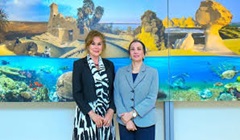
Egyptian Minister of Environment Yasmine Fouad met with the Mexican Ambassador to Egypt, Ms. Leonora Rueda Gutierrez, to explore ways to strengthen bilateral and multilateral cooperation in the environmental field and address shared environmental challenges.
The meeting was also attended by Ambassador Raouf Saad, Advisor to the Minister for Multilateral Agreements, and a representative from the Ministry of Foreign Affairs.
At the outset, Ambassador Rueda congratulated Fouad on her appointment as the new Executive Secretary of the United Nations Convention to Combat Desertification (UNCCD). She emphasized the importance of this role, particularly in addressing the pressing issues of desertification and its interconnection with climate change and biodiversity. The Ambassador expressed confidence in Fouad’s capabilities, citing her extensive experience and Egypt’s shared environmental context with Mexico and other developing nations.
Fouad highlighted the strong environmental ties between Egypt and Mexico, particularly since Egypt assumed the presidency of the UN Convention on Biological Diversity (CBD) from Mexico in 2018. She noted that Mexico had laid the groundwork for the development of the post-2020 Global Biodiversity Framework, which Egypt helped advance during COP14. Bilaterally, the two countries also cooperate in areas such as green transformation and the circular economy.
The Minister recalled that during Egypt’s presidency of the CBD, President Abdel Fattah El-Sisi launched a global initiative to integrate the three Rio Conventions—climate change, biodiversity, and desertification—into a unified framework. She stressed that despite being historically addressed in isolation, these challenges are deeply interconnected, especially in Africa, where desertification, biodiversity loss, and climate impacts threaten land use and food security.
Fouad underscored the urgency of addressing desertification amid today’s global challenges—including rising conflict, climate change, and food insecurity. She emphasized that countries like Egypt and Mexico, though minimally responsible for global emissions, bear disproportionate burdens. She identified 2026 as a pivotal year for demonstrating the credibility of multilateral action through the outcomes of the three major UN environmental conventions. She called for realistic, replicable models and greater political momentum to mobilize funding through mechanisms such as the Global Environment Facility.
She also pointed to Egypt’s experience in nature-based solutions as a model for addressing climate and environmental challenges, especially given similarities between the Egyptian and Mexican coastlines. These solutions, she explained, offer cost-effective ways to reduce biodiversity loss, preserve agricultural land, and support sustainable livelihoods.
Fouad affirmed Egypt’s commitment to multilateral cooperation, despite ongoing global and regional challenges. On a bilateral level, she highlighted Egypt’s success in transforming years of accumulated waste into a comprehensive, integrated waste management system. This system, anchored by Egypt’s first waste management law in 2020, focuses on two key pillars: the circular economy through waste reuse, and a shift from state management to private sector participation. Egypt has since built supportive infrastructure, encouraged private sector engagement, and clarified the roles of all stakeholders to ensure effective implementation.
For her part, Ambassador Rueda expressed her enthusiasm for deeper cooperation between Egypt and Mexico at both bilateral and multilateral levels. She noted the shared environmental challenges and the potential for exchanging expertise—particularly Egypt’s successful experience in turning environmental issues into economic opportunities, such as in waste management.
She further noted that Egypt and Mexico could be strategic partners in tackling the impacts of desertification on agriculture, a pressing concern for Mexico. She also highlighted the challenge of managing floods and the need for modernizing agricultural practices. Mexico, she said, is seeking best practices to improve its traditional agricultural systems and to enhance education around biodiversity and sustainability.
Source: Egypt Today